


Today was all about the Olympics and finishing my book (which I really enjoyed and recommend!)


January 26, 2022

One of the most important avenues to becoming a critical reader is simply to read more, and to read a variety of styles, voices, and subjects. The more ideas and perspectives we come into contact with, the more we are able to really understand our own perspectives and the way in which we choose to situate ourselves in our beliefs and understanding of the world. It’s crucial. Those who are not good, mindful readers–of texts, of media, of people–are simply at the mercy of whatever perspective they encounter. They are helpless against tricks and rhetorical arguments they can’t see through or don’t have enough experience to critically navigate.
January 24, 2022
I gave my students several prompts to choose from to write some literacy narratives: stories about the way in which people, moments, or events helped shape their sense of themselves as readers and writers. I thought I'd write to a couple of the prompts along with them.
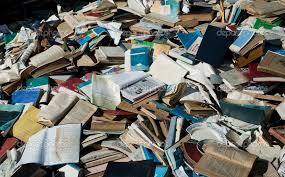
My tendency toward book hoarding might very well have begun when I was the very young age of seven or eight. I enjoyed reading, but probably loved all subjects equally at that age–I hadn’t really seen a front-runner emerge in terms of academic interests. However, a random instance of the right place at the right time probably went a long way toward tipping the scales.
My brother and I were bus riders. Our parents worked, so we clamored on the neighborhood school bus at the end of each day and got deposited some four or five blocks from our house. We walked the rest of the way home alongside a handful of other kids from our block, with Gary tasked with making sure I didn’t get lost on the way.
Several weeks after walking the familiar route home, one day we saw a giant orange dumpster parked in front of one of the houses a couple of blocks from our house. I don’t know why the first instinct of a couple of the boys was to climb up and peek in since we all knew that dumpsters were for trash, but I suppose they thought they might be lucky and find an old discarded baseball glove or deflated basketball, or even an old broomstick handle that they could fashion into a makeshift sword to wield at the rest of us for fun.
The big dumpsters have metal ladders permanently affixed to the side. The curious boys scrambled up and surveyed the possibilities. One by one they climbed back down, scowling in disappointment. Gary asked what they had seen. “Worthless!” one of the boys grumbled. “The whole thing is filled with old books!” My ears perked up. Gary’s did too. He climbed up.
“They’re right, Donna! Tons of books!” He disappeared down into the dumpster and scoured the titles. He came back down with a few. I begged him to let me find some books too, and he told me I could as long as I was careful. I could barely contain my excitement. Once I reached the top of the ladder my eyes were greeted with a veritable treasure trove. Hundreds and hundreds of books had been tossed in–paperbacks, hardbacks, westerns, romance, classics–as far as the eye could see. Some of them were missing book jackets or had torn pages, some of them were well-worn and others were in much better condition. It was as if an entire library had been upended into the dumpster. I reached down and picked up a book or two to read the back of the dust jacket to see which ones I wanted to take. I got a little mired in indecision. How could I just pick a few?
Gary grew impatient. He started yelling at me to get back out of the dumpster so that we could get home and have our afternoon snack. Although he was excited by getting a ‘new’ book or two, he wasn’t about to give up milk and cookies because of it. I told him I was having a hard time deciding. He said I could just grab a couple now and we could bring a bag the next day and take several more. That seemed reasonable. I took two that I had been contemplating and climbed my way back out of the dumpster. I was thrilled. Books, for free? With the prospect of seemingly infinitely more tomorrow? I’m quite sure that I skipped all the way home, unable to contain my joy.
The next day, I anticipated mining the mountain of books all day long. Gary and I had both brought bags from home to fill. After school, we walked quickly toward our intended destination. We rounded the corner to the street with the dumpster. It was gone! All of my excitement was crushed. Whoever had scheduled the dumpster to be delivered to the house had apparently already had it sent away, presumably to the local dump. What a waste! What a travesty! I had been THISCLOSE to having more books than I could possibly carry, and that dream was dashed in an instant. Never mind that most of those books were not likely books that would hold the interest and imagination of a seven-year-old. But the hope that maybe they were…it was heartbreaking. The books had been there, and then they vanished.
Years later, and more books than I can possibly count later, I have become something of a book hoarder. I haven’t read all of my books, though I’ve read many of them, and the fact that I own books I’ve yet to read certainly doesn’t stop me from buying new ones when a new title or storyline piques my interest. I can only imagine that when I see a new book that speaks to me, whispers its possibilities in my ear, there’s a seven-year-old girl whispering in my other ear, “Take it now while you can! Who knows if it will still be here tomorrow?”
January 22, 2022
I gave my students several prompts to choose from to write some literacy narratives: stories about the way in which people, moments, or events helped shape their sense of themselves as readers and writers. I thought I'd write to a couple of the prompts along with them.
When I was in sixth grade, we had a competition for reading in my class. My district was very competition-driven. My teacher, who was a hiking fanatic, had a giant butcher paper, snow-capped mountain covering the wall behind his desk, and each student was represented by a tiny push pin with our names affixed like tiny banners. We had a goal of a certain number of books to read by the end of the semester, and each week our little push pins would journey farther up the mountain in increments that correlated to the numbers of books we had read. The first person to meet their reading goal would summit the mountain and earn a prize.
The prize was one I can’t imagine being awarded in this day and age, but seemed perfectly reasonable then. Our teacher would take the winner out for dinner and a movie in the theater. The movie would be of our choosing. As I said, our school was very competitive, and in particular there was a boy named Derek Woolverton in my class with whom I had the fiercest–although friendly–competition. We were both in the top reading group, and each of us was determined to summit the mountain first. We read voraciously through the semester and maintained a neck-and-neck race all throughout. There was another student who joined us at the top of the pack, and ultimately, the three of us summited in the same week. There was a three-way tie for first place. Our teacher decided it was only fair that all three of us would share the prize.
We debated about the movie we would get to see. Derek was loudly advocating for Star Wars. I was not much interested. I wanted to see Ice Castles, a love story about a competitive skater who overcomes tragedy with the help of her dedicated boyfriend. I was able to sway our other competitor to my side, and Ice Castles won. I am sure that our teacher would probably rather have seen Star Wars, but he allowed us to diplomatically decide among the three of us, rather than weighing in himself.
I don’t remember where we went to dinner that night, but getting to go out in the evening to a movie theater with my teacher and two classmates was a true reward. Going to the theater at all was a rare treat back then. We felt like classroom celebrities–kind of a big deal when you are only ten years old. Once there, we got a big bucket of popcorn to share and allowed ourselves to be enveloped by the darkness of the theater. The music swelled, and the film came to life. We were entranced–even Derek, who was won over by the experience and didn’t hold it against us that he wasn’t sitting in the theater watching Star Wars.
It was the days before the internet, and Nextflix, and the likes of HBO. When we did watch films or television shows, it was almost always on the small screen on one of the three channels available to us at the time. A real, larger-than-life movie was a novelty, and although I was engrossed in the film and it made me cry in all the places it was designed to tug at my heartstrings (yes, even back then I was an emotional and sentimental girl), one of the things that I can distinctly remember was that there was so much swearing. It was a rated PG movie, but it was a 1970s PG, which meant PG encompassed a whole lot more language, nudity, and violence than the films of today. This was even before the PG-13 designation came along, so the net was even wider for films that fell into this PG category. I can remember clearly that it was almost as though there were two sides of myself watching–the one absolutely enjoying the storyline and the whole experience I had earned, and the other side that was very definitely worried that our teacher would get in trouble for bringing three young, impressionable kids to this movie. My own parents didn’t swear at home, and this movie was probably the most swearing I had ever heard in a concentrated two hour block. Although I wasn’t offended by it, I thought perhaps if my parents knew, they would get angry.
Ultimately, when I got dropped off at home and my mom asked me if I had enjoyed the evening, I told her all about it–sans the swearing. She smiled and told me she was glad I had had a good time, and that she was proud of me for earning the reward, and then she sent me to bed. It was late, and there was school in the morning. The movie and the experience remained a treasured memory for me for a very long time, and the film remained one of my favorites for several years. I had already been a dedicated reader by the time that competition came along, but being celebrated for it even further cemented my life-long love for it.
January 18, 2022
I gave my students several prompts to choose from to write some literacy narratives: stories about the way in which people, moments, or events helped shape their sense of themselves as readers and writers. I thought I'd write to a couple of the prompts along with them.

You never really recognize the unusual circumstances you might find yourself in if you have nothing with which to compare that circumstance. When I moved from Garden Grove to Clovis, California in the fourth grade, the discrepancy between the two schools was something that would inform my life and place me on a trajectory I might possibly never have traveled otherwise.
I loved school, and in my early elementary days I was a good student. I was the kind of student most teachers enjoy having: quiet, compliant, relatively intelligent, and a people pleaser. What’s not to like? I caused no one any trouble, nor did I ever raise any alarms, neither behaviorally nor academically. I was the kind of kid that made a teacher feel good about herself, because I was a ‘success’ under her tutelage.
In Garden Grove, we had a specialized Reading Lab. Once a week, our teachers could schedule time to go in and rotate through various stations designed to grab our interest and attention. There was a variety of machines, presumably state-of-the-art at the time (but which would now be seen as amusing relics of the past), on which we could take turns playing games, challenging ourselves to speed reading, and creating art to signify short stories we read. We clamored around the stations and excitedly awaited our turns at each. Reading Lab was seen as a privilege, and it was one that could be taken away if the class misbehaved during the week. It was a powerful incentive; we thought when we were in the Reading Lab we were getting away with playing during school hours, instead of what many saw as enduring the tedium of the classroom. Little did we know that our teachers knew something we didn’t; having the reward of self-selected and self-directed reading was one of the most powerful learning tools at their disposal.
Reading at my elementary school in Garden Grove wasn’t celebrated or made to feel unique or even aspirational. It was simply part of the culture of the school. As far as I know, our teachers didn’t preach about how important reading was, or how we needed to excel in it if we intended to succeed in life. We just lived it. It was understood.
In the middle of fourth grade, I moved to Clovis and started just after Christmas break. Naturally, on my first day my teacher needed to assess my abilities and skills. She needed to know what I knew already, and where I would need support. At the beginning of the day, she sat me down to run through a series of diagnostic reading tests. I found them to be almost comically simple at first, and even as we progressed through the levels I flew through each one, missing no responses. My teacher was impressed. She continued with the assessments until I had reached the highest level, which still posed no challenge. She showered me with praise and her wide smile gave me all the feedback I needed. I felt like a genius, and she looked like she had won the lottery with her new student. I was going to like this new school. In my old school I was a good student, as I said, but as far as I knew, nothing remarkable. This new teacher seemed to think there was something special about my aptitude for reading and vocabulary.
I rode on that emotional high throughout the morning. We went to lunch (where the cutest, friendliest boy was ‘assigned’ to help me navigate the cafeteria and the playground, which he did with charm and a willing attitude), and once the bell rang to return to classes, I found where my classmates were congregated to follow them back to our room. That’s when the trouble began.
Since I started in January, classroom routines and procedures were already well-established and ingrained in the students. They all knew that after lunch they would silently file in, sit in their seats, and await the next task. I found my way back to my seat and waited silently with them as my teacher efficiently passed row by row to deposit an assignment on each desk. Without saying a word, she moved from the last student’s desk to her own, picked up a timer, and elaborately set it. “You have three minutes. Go!” Her voice was loud and abrupt, breaking through the silence.
My classmates ducked their heads and began furiously scribbling. The only sound in the room was the sound of pencils on paper. I looked down at my own paper. On it were rows and columns of boxes with numbers and ‘X’s in each one. I sat staring, not moving. “What am I supposed to do with this,” I thought, bewildered, “and why on earth is the alphabet mixed in with the numbers?” In fourth grade at my old school, I had not yet been introduced to multiplication, and certainly not to the very competitive, speed-driven 3 minute Math Facts exercise that was so popular in my new district. I couldn’t begin to fathom what I was supposed to do with 3 ‘x’ 4, let alone know how to do it in a speedy fashion.
I am a people-pleaser at my core. I had never encountered a situation where I was utterly at a loss in school, and I was horrified that the teacher who was singing my praises earlier that morning was going to be disappointed in my complete lack of ability to understand the task at hand. I was also a relatively shy kid, and being new, I was reluctant to simply tell my teacher I was confused. It was humiliating. So I did the only thing I could think of. I lifted the lid of my desk quietly and pretended to search the inside of it for a pencil, presumably to be able to get my Math Facts done alongside the rest of my classmates. Tears had sprung to my eyes and I couldn’t keep them from rolling down my hot cheeks, so I tucked myself further and deeper into the desk. It didn’t occur to me that the sight of me hiding under the lid of my desk wasn’t nearly as discrete and clandestine as I thought it would be. Within seconds my teacher was kneeling at my side, trying to quietly lure me back out from inside the desk. She seemed surprised and concerned to find me crying. “What’s the matter, Donna? Are you okay?” I explained to her that I had no idea what this paper was on my desk, or what to do with it. “It’s multiplication,” she said quietly, as if that was all the explanation needed. I blinked at her, a blank stare indicating the words meant nothing to me. “You don’t know your times tables?” Continued blank stare. A slight shaking of my head. She went over to her desk and pulled out a little study sheet to help me learn them. I thought that perhaps she was rethinking her earlier assessment of me as a star pupil. Math would be my undoing–in my eyes and in hers.
My old school was apparently pretty advanced in the teaching of reading–and woefully nonchalant about teaching math. My new school, though they took reading seriously, was much more enamored of math, from the very early grades. Being able to score 100% on a 100-problem math facts sheet (front and back!) in the three-minute time frame was a badge of honor. Naturally, it took a very long time before I was able to catch up to my classmates and achieve that benchmark. From my very first day in my fourth-grade classroom, I started to see myself as a star reader, and a sub-par math student. Before I had only ever seen myself as a student. The distinction wasn’t really anything having to do with me–I hadn’t suddenly grown as a reader or lost I.Q. points as a math scholar between schools. It had everything to do with the focus each school had placed on the different subjects, though I wouldn’t have been able to articulate it at the time. But on that day, a divide began to grow between my reading and my math-oriented selves. When we experience success at something, we have a positive connection to it, and it makes us want to do more of it. When we experience failure, we often avoid the very thing where we feel we failed. After that day in elementary school, I wanted to read often, and as much as I could. I felt validated, strong. I continued to get positive reinforcement from my teachers and my peers for my reading ability. I tried to engage in math as little as possible, because I associated it with that feeling of confusion and helplessness. The more I read, the better I got, and not giving that same kind of attention to studying math, I did not grow at the same rate. I fed what I perceived to be already strong, and reinforced that reading and language were the subjects for which I was best suited. Years later, I find it no wonder that my chosen path was to become an English teacher.
And yet…I have always wondered what would have happened if I had not changed schools. What would have happened if I had continued on the same path, feeling right on par with my classmates in both of those core subjects? What if I had never gone to a school where suddenly the differences in my schools had instead translated to a difference in my own ability–to myself and to my teachers? I think I still would have enjoyed reading had I remained at my first school, but would I have thrown all of my concentration into that subject because that’s where I found comfort and solace? Would I have ever encountered a time when my math abilities were a disappointment at my former school, or would I have continued to give my studies in math equal weight, as I would not have shifted my perception of myself as a math student? That single day, decades ago, defined a part of me, and every step I took thereafter solidified and reinforced that definition, without me having realized it.
January 17, 2022

When I was an elementary student, there were a lot of phases I went through in terms of genres I read. The earliest I can remember was probably humorous poems. I remember being introduced to a poem by my second-grade teacher called “The Backwards Poem”. I can still recite it to this day. It began, “One bright day in the middle of the night, two dead boys got up to fight.” My little primary school brain thought it to be a very clever poem, and I sought out other humorous poets, like Shel Silverstein and Dr. Seuss. The sing-song nature of these poems was infectious and delightful to me. I loved the musicality and the rhythm in them. I’m sure my mother, on the other hand, got tired of hearing me say, “Hey Mom–listen to this one!” over and over again while she was trying to cook dinner and clean up after five young children every night.
About this time I was also very invested in comic books. Most specifically, I loved the Archie comics, but I also read a fair share of Daffy Duck, Richie Rich, and a wide variety of superhero comics. I don’t know when I first got ahold of one of those brightly colored magazines that told the antics of Archie and the gang, but I do know that I associated those comics with trips to visit my grandparents. Every year my parents would pile all five of their California kids into the back of our 1970’s Plymouth Station Wagon and we would make the long trek across five states to visit Grandma and Grandpa Mayes for a white Christmas. Although it didn’t always snow, most years it did, and it was magical for kids who lived in Garden Grove, California, where the winters consisted of only slightly chilly temperatures in the deep of winter. In order to occupy us on those long drives–it must have been quite the undertaking to drive five kids under 11 halfway across the country–my mom gave us some of our Christmas presents early. Anything that could entertain us on the road became an early gift: comic books, Colorforms, Rubic’s cubes (for the older kids), baby dolls, toy trucks, or anything that didn’t have too many pieces and didn’t make noise. Comic books were one of the favorites.
In my later elementary years, I found mythology. There was a copy of Bulfinch’s Mythology that I must have checked out and re-read five or six times during my fourth-grade year. I was fascinated by the capricious ways the gods manipulated humans and each other. They were often temperamental and fickle, but just as frequently cunning and creative, and sometimes sympathetic. It was my first real glimpse of characters with depth and multi-faceted personalities. The Dick and Jane readers we had when I was learning to read didn’t have motive or struggle or conflict; that simply wasn’t their purpose. But these mythological stories were not only meant to teach lessons; they intended to be entertaining and engaging, and they were. It wasn’t until much later that I learned that what I thought of as ‘mythology’ was only one set–albeit a well-known set–of cultural myths handed down from generation to generation. Learning the Greek myths weren’t the only kinds of cultural mythologies was one of my initial epiphanies that societies often privilege one voice over all others, and that seeing those other voices and stories and cultures was an act of stepping outside of one’s own experience in the world to learn about others. In order to learn about other cultures’ mythologies, I had to go out of my way to find them.
In fifth grade, I found my way into fairy tales. It was a natural progression from the mythological stories I had been reading. I don’t mean the Disney versions of the tales, I mean the dark and sometimes gruesome stories of the Brothers Grimm. Again, my school library was the home of a giant book of these tales, and after having checked out this book a couple of times to read, I saw that there was another book, similar in size and content. I started digging into the fairy tales of Hans Christian Anderson. The horrifying “The Red Shoes” and the ridiculous “The Emperor’s New Clothes” were among my favorites. It’s strange that although I strove in real life to be friendly, kind, and happy, and was very much a people-pleaser, I was drawn to some relatively dark stories where people’s bad behaviors were often dealt with through some of the harshest punishments meted out.
At the same time I was deeply entrenched in the worlds of fairy godmothers and evil goblins and magic and spells, I also stumbled upon one of the first non-fiction books I ever remember reading. Somehow I stumbled upon Helen Keller’s The Story of My Life, and it was transformative. I read about a young girl who was trapped in her silent and dark world, frustrated and angry about not being able to communicate with anyone. Her world collided with Annie Sullivan, seemingly the only person who, with persistence and determination, could manage to slowly chip away at the wall Keller found herself behind. Deaf and blind during that time in history, Keller could easily have been pushed aside, abandoned, or worse, and yet fortune or destiny or chance matched her with the woman who would teach her the way to communicate the fierce intellect and fiery spirit that had been bound up inside her. It was another book I read and re-read, and it made me realize two very important things. The first was that we never really know what is going on in someone else’s mind unless they are willing or able to share it. The second was that people’s lives, their everyday existence, could be a story. Our lives are stories. Every one of us has one to share. I went on to read other autobiographies and biographies, notable among them was the story of Joan of Arc. Her faith, confidence, and selflessness were undeniably inspirational and awe-inspiring. And at such a young age! I guess even in my pre-teen days, I was drawn to stories of strong powerful women who made their mark.
At this point in my young reading life, my fiction and non-fiction fares continued on parallel lines. Fiction found me moving from fairy tales to stories of witches and witchcraft, while my interest in non-fiction progressed from learning about strong people in history to learning about history itself. I became engrossed in World War II, and more specifically, the Holocaust. If my mother had paid the least bit of attention to what I was reading, she might have been concerned. She didn’t, however. I was a good kid, did very well in school, and caused no trouble for anyone. It never even occurred to her to pay attention to what I was reading; she was just happy I could occupy myself for long stretches of time. Not that I was reading either of those genres as how-to manuals or anything. The stories about witches and witchcraft tended toward the lighthearted and fanciful, something like “Bewitched”, but there was definitely a dark and sinister tone to some of the books I read. I didn’t get too entrenched, though, because while I wasn’t entirely sure whether or not I believed in that kind of supernatural power, I was smart enough to know I didn’t want to take any chances of accidentally signaling to some otherworldly figure that I might be interested in joining their ranks or somehow raising their ire. (To this day, this is my rationale for not dabbling in such seemingly childish yet somehow sinister games like playing with a Ouija board.) I imagine my interest in reading so much in this genre during this time, if I had to step back and look at it objectively, is that there was a lot of tension and instability in my household during that time, over which I had no control. Perhaps reading about witches who had the power to manipulate and change circumstances for themselves or others gave me a little solace and a vicarious sense of power. The Holocaust books I read during that time were almost entirely first-hand accounts of survivors of the concentration camps–an extension of my autobiography phase–and served as a counterpoint to the books about witchcraft. Books about witchcraft were about wielding power over others, whereas survival memoirs were about the physical, emotional, and spiritual damage done to human beings when those in power give in to their unfettered desire for control and lose sight of humanity. The atrocities I read about in the books about the Holocaust were far more horrific than anything I read about in the fictional stories of revenge-driven witches. Humans have great potential for rising above adverse circumstances and persevering through trauma, but so do we have a terrible potential to give in to our basest desires and put self above all others. It is up to us to decide which story we want written about us in the end.
From a young age, books have been a constant companion for me. They were a way for me to not just try on identities and learn about parts of myself that were fledgling characteristics at the time, but also to try on ideas that were unfamiliar to me. They allowed me to grow an understanding of the world around me and begin to understand the nature of human beings, both good and evil, from a safe space within the confines of my home and my library. I retreated into the world in between pages so that I could step out into the world I inhabited with a better understanding of how I fit into it.


 Posts
All Comments
Posts
All Comments


